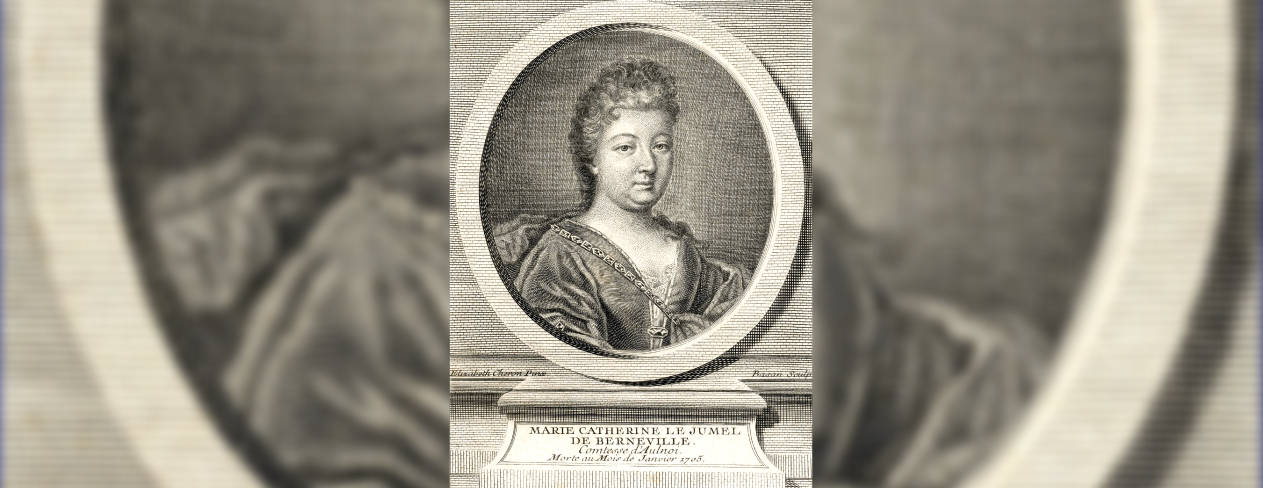
Now that the name of Princess Schwarzenberg has been spoken, can we expect the intrigue to ignite? Hardly. What would your reaction have been to such a silly, childish tale? Would you have taken it seriously? I suspect not — and neither does Marianne. Instead, the two sisters settle themselves comfortably to read some fairy tales by Madame d’Aulnoy.
Madame d’Aulnoy (1650–1712), a most remarkable and prolific writer, was a true pioneer of the genre. Her tales were strikingly femicentric, presenting strong, independent female characters, close friendships between women and their mutual support. La Belle aux cheveux d’or rules her realm independently and chooses and crowns a king herself; La Chatte Blanche (who is in fact a princess) bestows an entire kingdom upon her beloved, since she possesses several; La bonne petite souris (again, a princess), together with her mother the queen and her fairy godmother, successfully defeats an intruder.
Thanks to authors like Madame d’Aulnoy, a boom in literary fairy tales swept through intellectual circles. For a brief moment in time and space, an entire literary genre was dominated by women — a rare, perhaps unique, phenomenon in the history of Western literature. In later tradition, their contributions were overshadowed (and interpreted far more conventionally) by male writers such as Charles Perrault and the Brothers Grimm, to name only the most well-known.
Access to the Metatext via placing an order for an augmented product. See Terms of Use
We use cookies to ensure that we give you the best experience on our website. If you continue to use this site we will assume that you are happy with it.