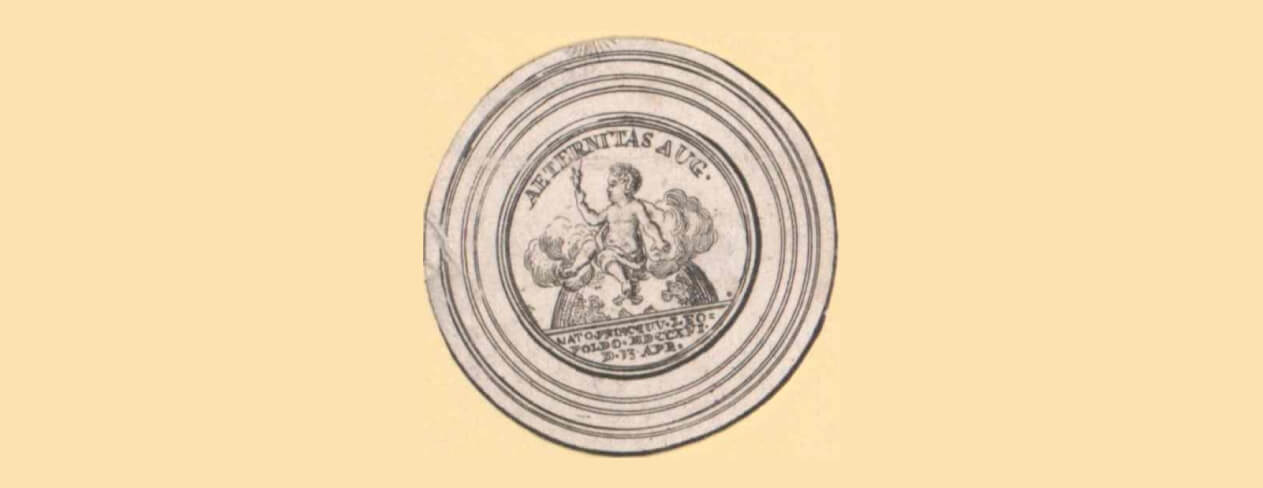
Archduke Leopold Johann died on 4 November 1716. Quite unaccustomed to the Habsburgs, his parents, Emperor Charles VI and Empress Elisabeth Christine of Brunswick-Wolfenbüttel, were not closely related and therefore could expect to have healthy children. After seven years of marriage, their hope was finally fulfilled. True, the baby seemed rather fragile and slightly deformed — but he was a son, after all! Everyone breathed a sigh of relief that the succession now seemed secured.
Without ever leaving his nursery, the birth of such a precious child caused quite a stir at the Viennese court. A small army of archbishops, bishops, abbots, ambassadors, and envoys of foreign courts, led by the Papal Nuncio, was summoned to perform his solemn baptism. On his very first day of life, the baby received the Order of the Golden Fleece, and several commemorative medals were minted to celebrate his arrival into this world. Composers and poets created operas, hymns, and music of homage in his honour, while actors performed musical comedies and dance plays.
As momentous as the consequences of Leopold Johann’s birth were, those of his death proved even more decisive. At the age of six months and twenty-one days, the ailing infant left this world. He remained the last-born male Habsburg, whose premature death doomed the main line of the dynasty to extinction.
At this tragic time, the Empress was expecting again. Six months after Leopold Johann’s burial, Elisabeth Christine gave birth to a daughter. She was baptised Maria Theresa.
Access to the Metatext via placing an order for an augmented product. See Terms of Use
We use cookies to ensure that we give you the best experience on our website. If you continue to use this site we will assume that you are happy with it.