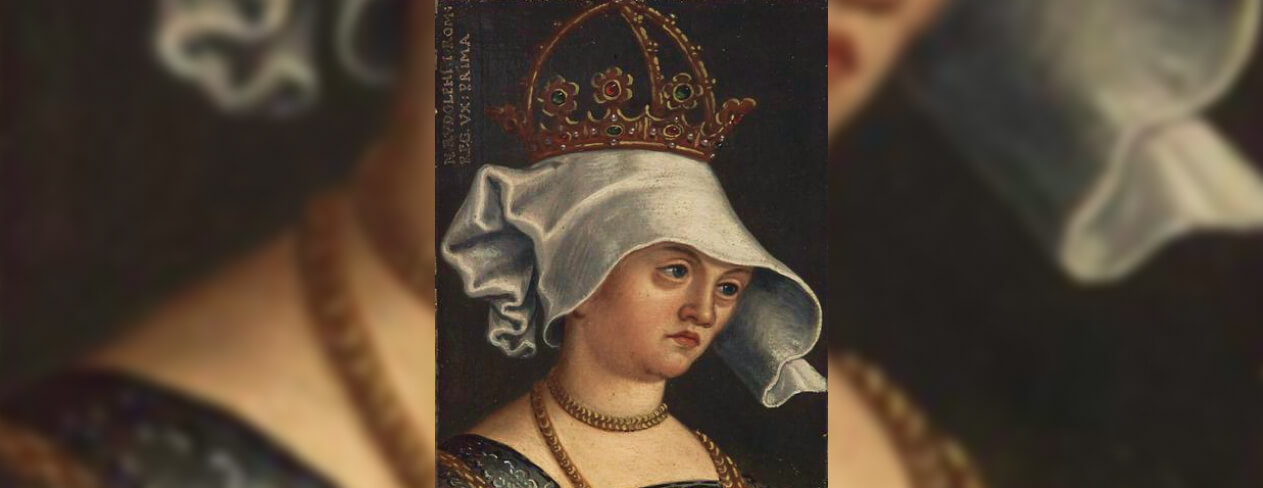
Gertrude of Hohenberg passed away on 16 February 1281. Descended from a noble family, she married Rudolf I of Habsburg, then Count Rudolf, the head of the still relatively modest House of Habsburg. For nearly twenty years, Gertrude lived the ordinary life of a medieval noblewoman, raising children and presiding over her husband’s small comital court.
Yet the times were turbulent. The Great Interregnum had left the Holy Roman Empire without an emperor, and the quarrelling princes were unable to agree on who should fill the imperial vacancy. Meanwhile, Count Rudolf proved himself a capable and energetic ruler in his own lands. He secured control over Austria, Styria, and Carinthia, laying the foundations for the rise of the Habsburg dynasty. Paradoxically, Rudolf benefited from his relative insignificance on the imperial stage: in the eyes of the leading princes, he was not powerful enough to threaten their own independence. Thus, in 1273, Rudolf was elected King of the Romans — the traditional title of an emperor-elect between election and coronation — although he never received the latter.
At her husband’s side, Gertrude became Queen of the Romans, taking the name Anna. She fulfilled this royal role for eight years until her death, without involving herself in political affairs. Through her daughter Margaret, she became the grandmother of Emperor Louis IV, known as The Bavarian. Another daughter, Clementia, married Louis X King of France.
Access to the Metatext via placing an order for an augmented product. See Terms of Use
We use cookies to ensure that we give you the best experience on our website. If you continue to use this site we will assume that you are happy with it.