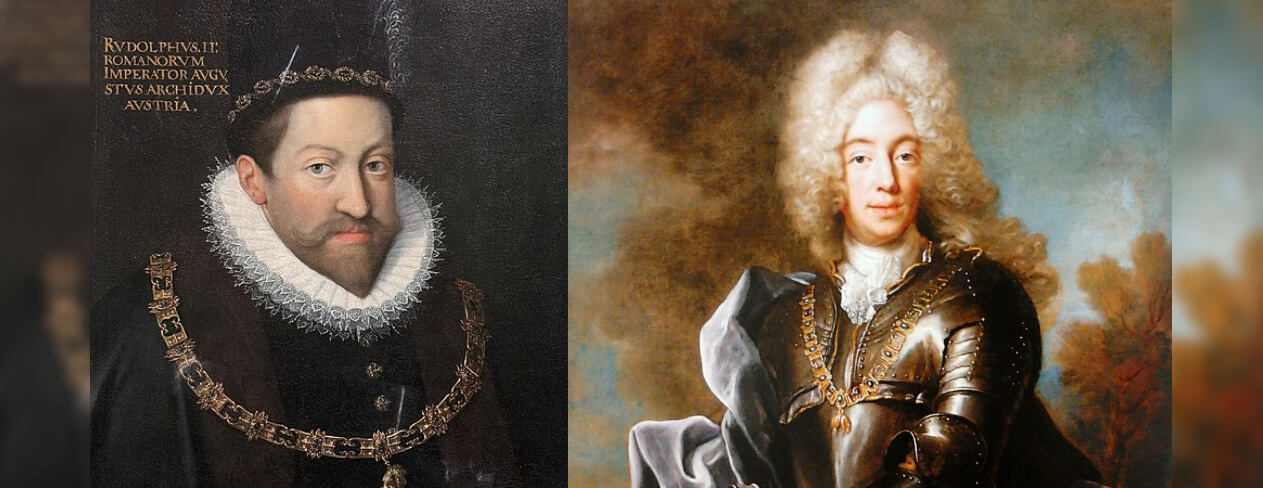
Two rather peculiar figures on the Imperial throne share the date of their departure from this world.
Emperor Rudolf II passed away on 20 January 1612. Educated, art-loving, and vivid by nature, he suffered from a progressive mental disorder. As the Empire faced decades of extraordinarily complex political and religious challenges, Rudolf gradually became reclusive and superstitious, immersing himself in occultism and alchemy. Incapable of effective rule, the Habsburg family council decided to strip him of all real power in favour of his younger brother Matthias.
From the Habsburg perspective, another event of relief was the death of Emperor Charles VII on 20 January 1745. Five years earlier, the main Habsburg line had become extinct, and war had erupted over Maria Theresa’s accession. Possessing only a small measure of Habsburg blood, Charles—then Elector of Bavaria—seized what he perceived as an opportunity to claim the Austrian inheritance. Lacking both resources and authority, he remained entirely dependent on the fortunes of war and even lost his residence in Munich to Austrian troops. His largely nominal three-year reign is noteworthy chiefly because it interrupted the Habsburgs’ otherwise continuous succession to the Imperial throne.
Access to the Metatext via placing an order for an augmented product. See Terms of Use
We use cookies to ensure that we give you the best experience on our website. If you continue to use this site we will assume that you are happy with it.