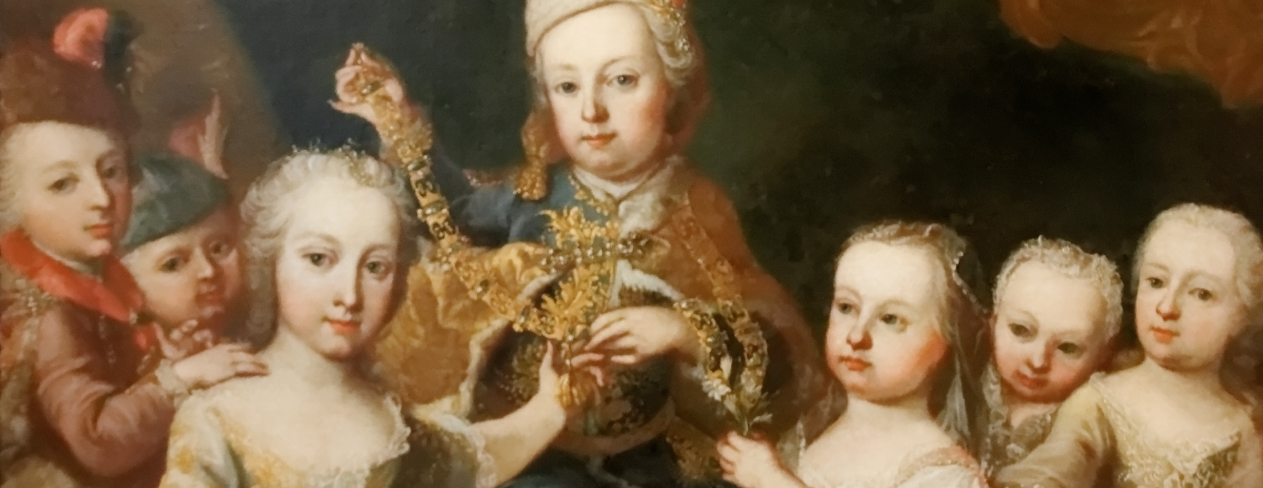
Despite my efforts to keep the number of characters as low as possible, a reader may still feel somewhat confused when trying to orientate among the counts and princes, ladies-in-waiting, courtiers and high-born visitors. Owing to the historical context, it is indeed quite a crowded narrative.
Let us begin by introducing the Imperial family. During their marriage, Maria Theresa and Francis Stephan had sixteen children. By the spring of 1757, thirteen of them were alive: eight daughters and five sons. Here is the full list of the siblings, with their familiar nicknames in brackets and their ages:
Maria Anna (Marianne), 18; Joseph (Pepi), 16; Maria Christina (Mimi), 15; Maria Elisabeth (Liesl), 13; Karl Joseph, 12; Maria Amalia (Mali), 11; Peter Leopold (Poldl), 10; Maria Johanna (Hannerl), 7; Maria Josepha (Sepherl), 6; Maria Karolina (Charlotte), 4; Ferdinand (Ferdl), 2; Maria Antonia (Toni), 1; Maximilian Franz (Max), 5 months.
Not all of them would reach adulthood; however, at the time of the narrative, these future family tragedies remain unknown. Two of the brothers, Joseph and Leopold, would later become Emperors of the Holy Roman Empire. The most famous of the siblings is undoubtedly Antonia – Marie Antoinette, Queen of France – who was executed by guillotine during the French Revolution.
Access to the Metatext via placing an order for an augmented product. See Terms of Use
We use cookies to ensure that we give you the best experience on our website. If you continue to use this site we will assume that you are happy with it.