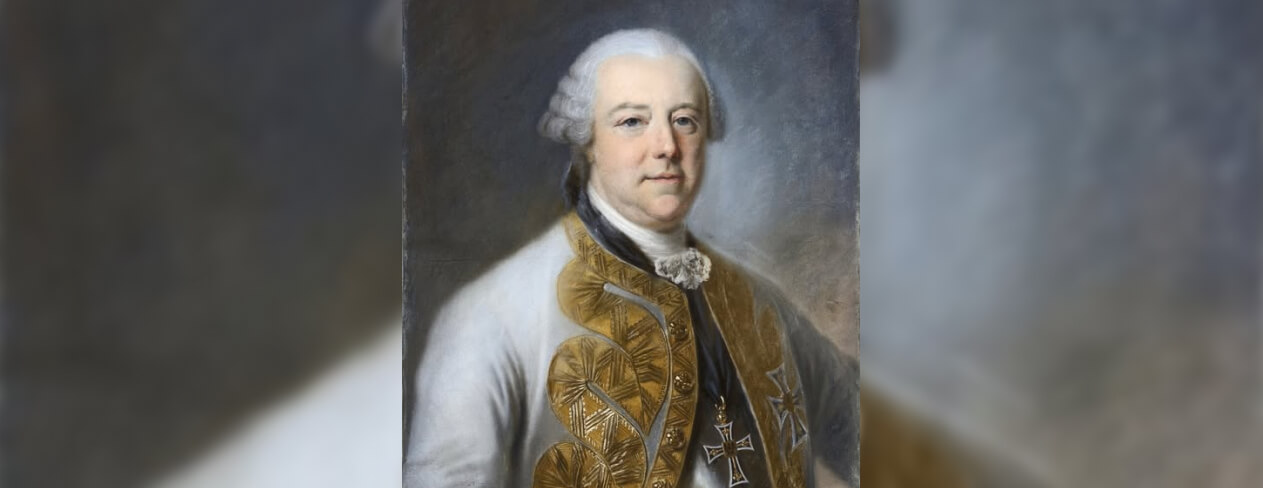
Prince Charles Alexander of Lorraine was born on 12 December 1712. He was the younger brother of Emperor Francis Stephan and the husband of Archduchess Maria Anna, the younger sister of Maria Theresa. The two Habsburg–Lorraine marriages created a double sisters-in-law and double brothers-in-law connection between the couples.
Despite standing closest to the Imperial family both politically and personally, Charles Alexander remains a somewhat elusive figure. In a biography of the Emperor, his brother, the phrase ‘Prince Charles was also there’ (auch Prinz Karl war dabei) appears repeatedly in one form or another – a curious acknowledgement of his constant presence combined with his relative insignificance. His military career, still half-mandatory for an eighteenth-century prince, consisted mostly of defeats with a few modest successes. Yet his personal relations with his brother and with Maria Theresa were always harmonious and warm.
Charles Alexander’s true strengths emerged when the Empress appointed him governor of the Austrian Netherlands. He proved to be a capable administrator, earning great popularity among his subjects. He was also a devoted patron of the arts: he supported promising young artists, subsidised their study trips, and commissioned their works. In 1757, exactly when the plot of my novel unfolds, construction began on a new palace in Brussels (today the Royal Library of Belgium) – an event I have the Prince’s sister, Anna Charlotte, mention in her correspondence with Archduchess Marianne, my protagonist.
Charles Alexander’s 35-year rule undeniably revitalised the cultural life of the Austrian Netherlands. He died in 1780 without legitimate heirs and left his considerable fortune to his nephew, Maximilian Francis.
* Franz Stephan. An der Seite einer großen Frau by Georg Schreiber.
Access to the Metatext via placing an order for an augmented product. See Terms of Use
We use cookies to ensure that we give you the best experience on our website. If you continue to use this site we will assume that you are happy with it.