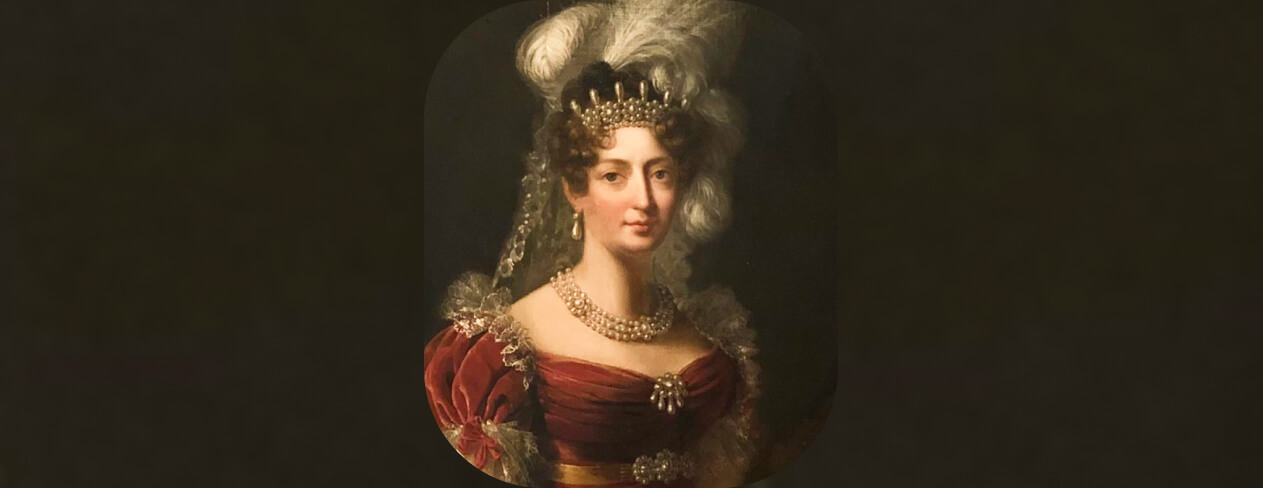
19 October – A Fille de France crowned with thorns
Marie-Thérèse-Charlottepassed away on 19 October 1851. She was the only surviving child of Marie Antoinette and Louis XVI. As a child, she endured her parents’ confinement and deposition, and the separation from her family during the revolutionary terror. She was the only one among all the royal prisoners to survive the Reign of Terror, yet those threats and losses fell upon her during her most formative and sensitive years. The devastating impact of such experiences on a teenage girl’s psyche is beyond ordinary imagination.
After being liberated in 1795, Marie-Thérèse-Charlotte spent most of her life in exile, dependent on the mercy of foreign monarchs. The small group of Bourbons wandered from palace to palace in places such as Edinburgh in Scotland or Mitau in Courland (modern Latvia) – which, from their point of view, must have seemed the very end of the world. In Courland, she married her first cousin Louis-Antoine, Duke of Angoulême, though their union remained childless.
The Bourbon Restoration from 1814 to 1830 brought the family back to France, where the distressed princess had to confront numerous impostors claiming to be her late brother, the legitimate King of France. The July Revolution of 1830 forced the remnants of the royal family into yet another exile – this time final – first again in Edinburgh, then in Prague, later in Gorizia (modern Italy), and near Vienna.
Marie-Thérèse-Charlotte lived long enough to drink every bitter cup of fate. She died of pneumonia at the age of seventy-two, only a few days after the fifty-eighth anniversary of her mother’s death. One might say it was the last family event she commemorated – at least in her heart. She was buried in the Kostanjevica Monastery in Gorizia (today in Slovenia).
Access to the Metatext via placing an order for an augmented product. See Terms of Use
We use cookies to ensure that we give you the best experience on our website. If you continue to use this site we will assume that you are happy with it.