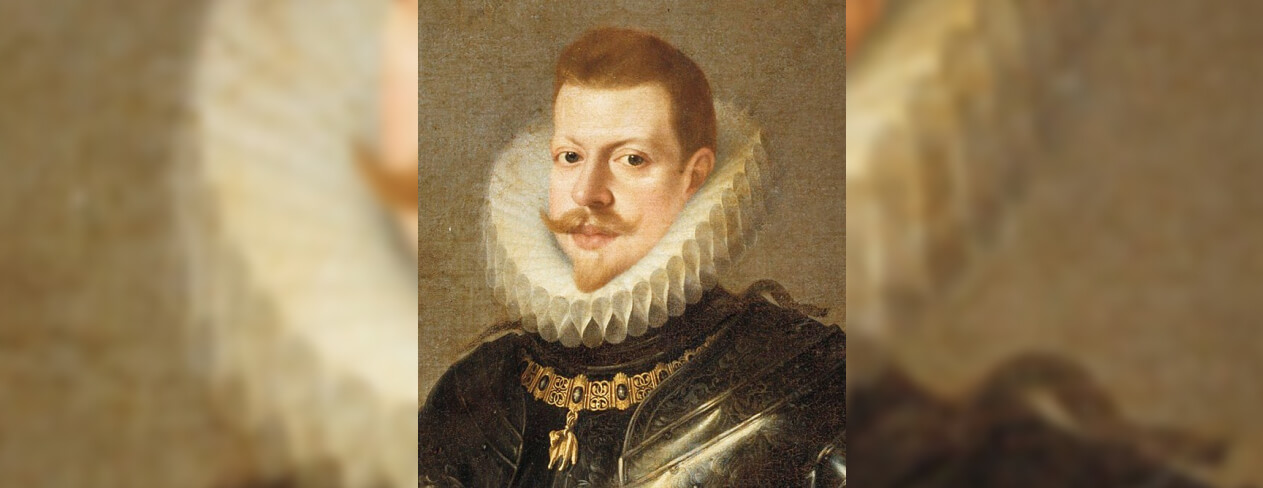
Philip III of Spain passed away on 31 March 1621. He was the only surviving son of Philip II of Spain, born to his fourth wife Anna of Austria, daughter of Maximilian II, Holy Roman Emperor. As the product of an uncle-niece marriage, Philip III’s kinship ties formed remarkably intricate patterns. His paternal grandparents, Charles V and Isabella of Portugal, were at the same time his maternal great-grandparents. Thus, their granddaughter Anna became the mother of their grandson. By comparison, Philip III’s own marriage to Margaret of Austria— his grand-uncle’s daughter, or first cousin once removed — could almost be considered distant by Habsburg standards.
Philip III was anything but a strong ruler, endowed with neither remarkable talents nor notable vices. Deeply religious and indecisive by nature, he distanced himself from the affairs of state, delegating power to his favourites,Duke of Lerma and Duke of Uceda. Despite the King’s personal passivity, Spain’s international position improved: peace was concluded with England, the independence of the Netherlands was effectively acknowledged, and good relations were established with France. The period also witnessed a flourishing of Spanish culture and literature, including the publication of Don Quixote by Miguel de Cervantes. And yet, beneath this outward calm, the underlying conditions of Spain’s gradual economic and military decline were already beginning to emerge.
Philip III and Margaret’s daughter Anna married Louis XIII of France and became the mother of the Sun King, Louis XIV of France. Another daughter, Maria Anna of Spain, became Holy Roman Empress through her marriage to Ferdinand III, Holy Roman Emperor.
Access to the Metatext via placing an order for an augmented product. See Terms of Use
We use cookies to ensure that we give you the best experience on our website. If you continue to use this site we will assume that you are happy with it.